By: Justin “Couz” Walker | WV Sports Chat
The landscape of college athletics continues to shift at a rapid pace. This is forcing athletic directors across the country to constantly adapt. With that, frustration also continues to mount.
With traditional NCAA governance seemingly losing its grip on the revenue-producing giants of the sport, a recurring question is starting to dominate headlines: Will the Big Ten and the SEC eventually break away from the NCAA entirely to form their own leagues?
Iowa State Athletic Director Jamie Pollard made headlines earlier this week when he said, “let em break away. I would turn it around and say we should break away from them. Let them go, but they have to go in all their sports…”
Per a report by Ross Dellenger, this statement by Pollard reportedly raised a lot of eyebrows in Big Ten country. It even became a major topic of conversation among Big Ten leaders at their annual spring meetings on Wednesday.
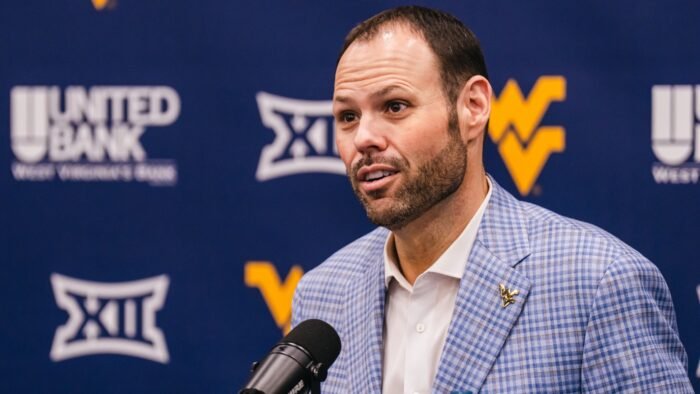
Jamie Pollard was not the only Big 12 Athletic Director to speak on the subject this week. During his annual spring press conference on Tuesday, WVU Vice President and Director of Athletics, Wren Baker, offered his thoughts on the matter. While his comments were much less controversial than Pollard’s, he did give a candid response. According to Baker, a breakaway by college football’s two premier conferences wouldn’t solve the structural chaos currently plaguing the sport. In fact, it might not fix anything at all.
The Breakaway “Fix”
When asked about the future of NCAA governance and whether any system can succeed without ironclad buy-in from member institutions, Baker addressed the mounting murmurs of a power-conference divide.
“I saw a story yesterday that there might be some—and I think it’s a minority—but inside the SEC and Big Ten that are talking about, ‘Should we break away?'” Baker noted. “I mean, there’s no evidence that that would fix anything.”
Baker’s skepticism is rooted in recent history. The idea that giving the wealthiest conferences total autonomy will magically bring stability to college sports has already been tested—and it failed.
“We come up with the autonomy four to get the ability to do legislation in the NCAA without everybody’s involvement—that didn’t solve it,” Baker explained, pointing to previous NCAA restructuring that granted Power Four conferences the freedom to pass their own rules. Furthermore, he highlighted that the heavyweights have already been driving the bus on recent legal resolutions. “This settlement… the autonomy conferences, and really the Big Ten and SEC, led the way. Their in-house counsel and outside counsel set a lot of those rules of engagement, and we’re not even a year into it.”
The core issue, as Baker sees it, isn’t the governing body itself; it’s the lack of a collective willingness to abide by a unified set of guardrails. “I just don’t know that whatever that breakaway is, if there’s not a commitment from whatever segment of schools it would be to actually abide by the rules, I don’t know how that really fixes any of the ills that we’re experiencing.”
The College Athletics Poker Game
To explain why college sports feels so unsustainable right now, Baker used a striking analogy. He compared the current behavior of university athletic departments to players in a poker game.
“It just feels like we’re all sitting at a giant table playing poker,” Baker said. “As long as somebody’s sitting there thinking they may have the best hand, they’re just going to keep up-ing the ante and trying to force other people out of the game.”
What is the Best Solution?
So, if a Power Two breakaway isn’t the answer, how does college sports find its footing? For Baker, the answer doesn’t lie within the athletic departments or the NCAA’s headquarters in Indianapolis. It requires intervention from Washington, D.C.
“People are a little bit at a loss for the best way to rein it in, but I think federal legislation is probably your best bet,” Baker concluded. “That’d be my guess.”
Photo Credit: WVU Athletics