
By: Landon Scott | WV Sports Chat
On January 13, the WVU men’s basketball team faltered at the Fertitta Center, receiving a beatdown at the hands of 7th ranked Houston Cougars. Despite Coach Ross Hodge’s own reputation for defense, it was Cougars coach Kelvin Sampson who provided a textbook lesson in protecting the hoop. Houston held the Mountaineers to 48 points on only 37% shooting from the field. In addition to forcing 15 turnovers, the Cougars suffocated West Virginia’s offense into extended dry spells throughout the game, including a near ten-minute scoreless run in the first half, which left WVU with only 5 points on the board 14 minutes into the game.
A deep dive into the statistics of the game reveals that Houston did not have an especially terrific night on offense, despite scoring 77 points. The Cougars came within a few percentage points of their season averages for field goal percentage, three-point percentage, and free throw percentage. All things considered, it was a fairly average night for Houston, one where they score consistently while stifling the opponent’s offense.
For WVU basketball, it was another major stumble away from the Hope Coliseum. The opening line favored Houston by 11.5, an enormous difference from the final 29-point deficit. It does, however, reflect a larger trend in the Mountaineers’ season. West Virginia is winless away from their home venue and have failed to cover the opening line in four of those six losses. It is difficult to call these true road games since four of the contests have taken place at neutral sites, including one at the Civic Center in Charleston against Wake Forest, a secondary home game for the Mountaineers. Only against Clemson (-3.5) and Ohio State (-3) has WVU covered the opening line. So, why have the Mountaineers struggled away from home so far this season?
An important detail to note is that all college basketball teams experience at least some diminished performance away from their home venues. Ask any Las Vegas handicapper and they will admit that home court advantage exists, and it can be worth three to four points a game, but even more in legendary venues like Cameron Indoor Stadium or Allen Field House. While the reasons for home court advantage are speculative, there are several answers accepted by most sports fans. Longer travel demands for young players, home cooking from the officials, passionate student sections, unfamiliarity with the arena and rims, or even being away from their friends and classes are all elements that can influence college basketball players. Realistically, it is a combination of these factors that dictate why performance can be slightly worse in road contests.
Notice the term “slightly worse” used above. By most metrics, the Mountaineers have been more than “slightly worse” in their away games compared to their home games this season. Using each game as an individual data point to help gauge good and bad “shooting nights” a trend begins to emerge. In games at Hope Coliseum, the Mountaineers shoot around 47% from the field and 38% from three. Compare this to non-home games, where West Virginia manages a pedestrian 40% from the field and 33% from three. The composition of shot selection varies little based on venue, with roughly 23.5 threes attempted per home game, and 24.6 three attempted per away game. While free-throw attempts decrease from 23.5 to 19 for road games, the Mountaineers’ free-throw conversion rate actually increases from 66% to 71%. Additionally, turnovers increase from 9.8 to 13.5, a difference not abnormal for D1 teams. In short, WVU shoots far worse away from home, unless they are shooting free throws. On the other end of the floor, the Mountaineers are allowing more points at a higher success rate during away games. The average score for opponents increases from 55 to 78 while shooting nearly 40% from three and 47% from the field, both of which are double digit percentage increases over home games. The good news for WVU fans is that there is an asterisk to this data.
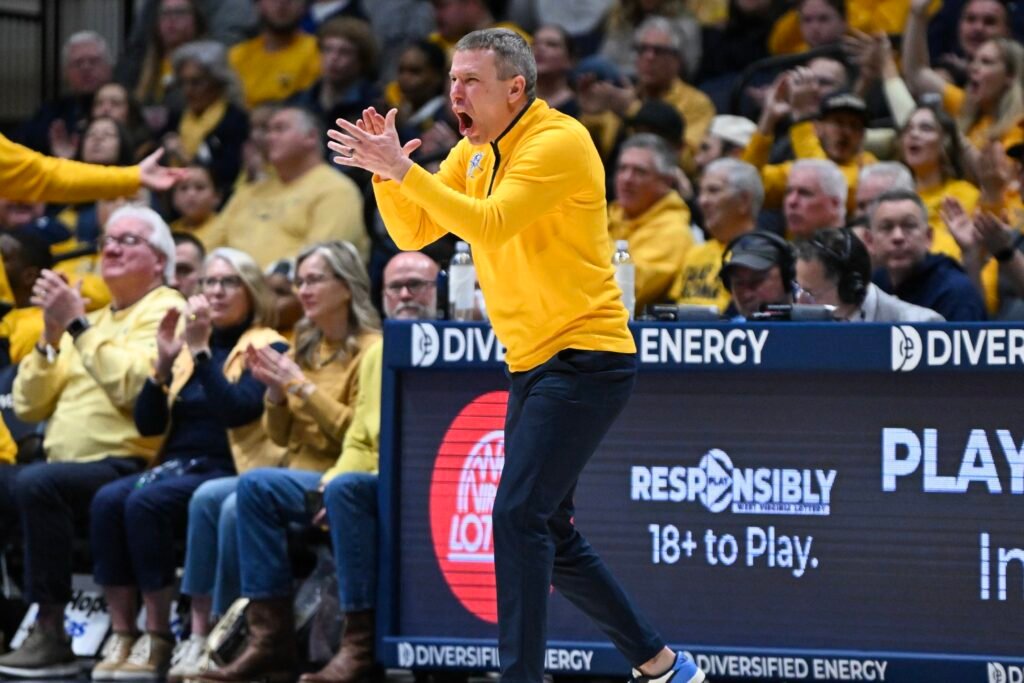
The six losses have occurred against Clemson (in Charleston, South Carolina), Xavier, Wake Forest, Ohio State (in Cleveland, Ohio), Iowa State, and Houston. As much as the Wake Forest game functioned as a home game for WVU, the same could be said for Clemson and Ohio State. The losses to Iowa State and Houston happen to be to two teams who, as of the writing of this column, ranked firmly in the AP top 10 nationally. They are also heavily involved in conversations to cut down the nets in March. Clemson has since ascended to the top of the ACC with a 15-3 record and 22nd overall ranking nationally. Xavier and Wake Forest have stumbled to 10-7 records while Ohio State struggled to a mark of 10-6, making those losses sting all the much more. Coach Hodge stated in the respective post game press conferences that these games were winnable, but they ultimately came down to mistakes on both ends of the floor. Away from home, WVU has been decimated by a few excellent teams, competed with one good team, and lost several close games to average teams. Their resume is not too different than many good teams in America.
Eight of the Mountaineers’ 11 home games have come against the likes of Campbell, Coppin State, and other low-major schools. These games have slightly inflated many of WVU’s statistics, but not dramatically. Only examining the stats against the P4 home opponents, Pittsburgh, Cincinnati, and Kansas, shooting percentages for and against WVU remain within about two percentage points of the original home-game figures noted above. A pathetic Pitt team, who was trounced 49-77 by WVU back in November, have fought to carry a winning record into conference play. The Panthers slightly skew the numbers in favor of WVU in this data set due to their poor performance. However, on the data for road games, Iowa State and Houston heavily skew that data against West Virginia. An old saying feels applicable for these latter two games: “good defense cannot stop even better offense”. Iowa State shot over 50% in the contest, and despite Houston having an average night on offense, their average night is still better than most. These games, regardless of the quality of opponent, cannot be labeled as outliers in this limited data set. The Mountaineers will need to play more games for a better understanding to take form.
What is clear so far is that the WVU basketball team has played a tough schedule away from home. However, they have not performed well in most of these games. The claim that the Mountaineers have played worse on the road is justifiable. However, an alternate theory of why they have struggled away from Morgantown does exist. When describing home court advantage earlier, one criterion was excluded. If an arena is in an atypical environment, which constitutes long flights arriving at adjacent cities, followed by long bus rides, a visiting team may struggle more than usual. It just so happens this criterion, along with all previously established conditions, describe the Hope Coliseum perfectly. WVU’s home court statistics are buoyed by the struggles of others in the Hope Coliseum. On Saturday, Kansas entered Morgantown holding a 22nd ranking nationally, only to be outshot from three and out-rebounded as a rambunctious crowd fueled a strong second half run for the Mountaineers that ultimately put the game out of reach. Despite being favored by 3.5, the Jayhawks departed the Mountain State with a losing margin of 11. As Kansas coach Bill Self would attest, The Coliseum has been a house of horrors for the Big 12’s preeminent power since WVU joined the conference.
The combination of West Virginia’s shooting woes on the road against tough competition, as well as the benefit of playing at a fierce home arena fuel the perception of performing poor away from home. In actuality, WVU performs very well at home, a result that is difficult to duplicate in any other arena. While Hope Coliseum is not mentioned along side Cameron Indoor or Allen Field House as a legendary venue, oddsmakers and fans would concur it is worth more than the 3 points awarded to an average home team in America. The Mountaineers’ road performance should stabilize with their Big 12 schedule easing following their visit to Tucson to clash with top ranked Arizona on January 26th. If WVU can apply lessons learned from their four tough losses and two blowouts, they could steal several key road games in conference play. Simultaneously, if they can continue their excellent home court performance, the Mountaineers may assemble a resume worthy of a March Madness bid.