By: Landon Scott | WV Sports Chat
The Associated Press is comprised of nearly seventy members, each of whom cast their ranked votes to formulate the top twenty-five football teams in America. Members have come and gone, dynasties have risen and fallen, and the NIL revolution has swept across college football – all since the West Virginia Mountaineers last garnered a ranking in the AP Poll.
The Associated Press released their 2026 preseason rankings on August 17th, extending West Virginia University’s absence to 119 consecutive weeks. The Mountaineers’ last appearance was the concluding poll of the 2018 season, seven years ago. The pitiful streak is the second worst in the power-four, trailing only Rutgers, who’s last appearance dates to the end of the first Obama administration.
With this streak in mind, it prompted an in-depth analysis of the past sixty years of WVU’s ranking within the AP Poll.
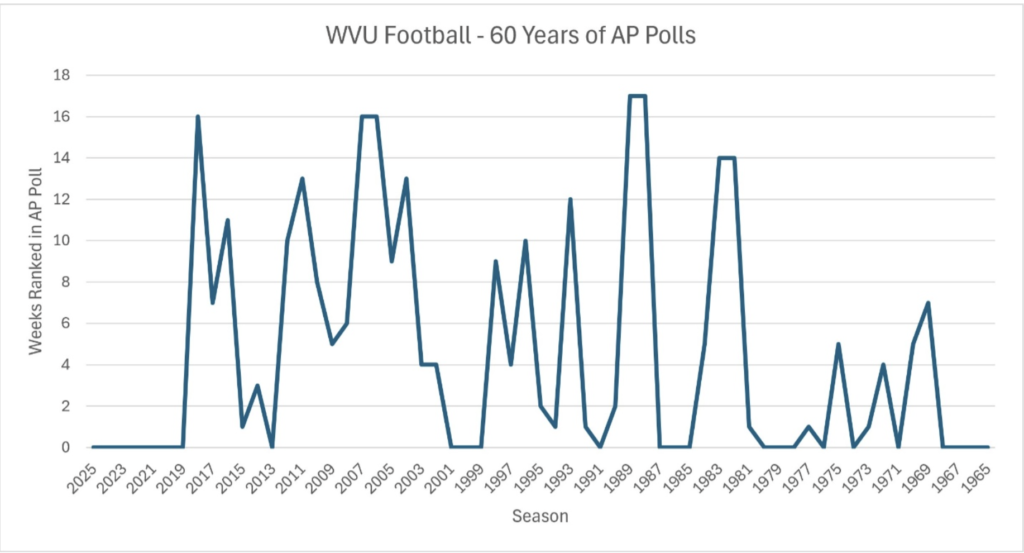
These periods featured multiple seasons containing zero to two appearances in the poll. Fortunately, each of these dry spells lead into prolonged periods of winning. Jim Carlen’s best season in 1969 jumpstarted the Mountaineer’s prominence under Bobby Bowden in the 1970’s.
Frank Cignetti’s struggles brought on the early years of Don Nehlen, who experienced several ebbs and flows in his own right.
The end of Don Nehlen and early struggles of Rich Rodriguez led to two BCS Bowl victories in the 2000’s.
Dana Holgorsen’s lull after his own BCS Bowl victory in 2012 produced double-digit win seasons and conference contending play in the mid 2010’s.
The swiftest changes in momentum come on the heels of coaching changes. The new commanding men either lift the program up early or keep it in the trenches. This is easily reflected by examining the total weeks a WVU coach was ranked throughout their tenure.
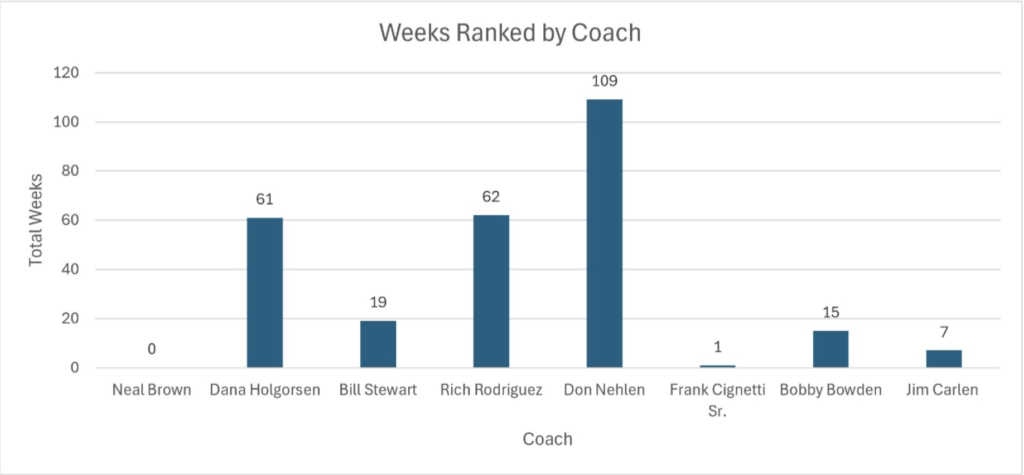
This leaves Bobby Bowden, Don Nehlen, Rich Rodriguez, Bill Stewart, and Dana Holgorsen as the highest achievers in the modern era of WVU football. Their performance, when examined as a percentage of weeks ranked during their given tenures, provide greater context.
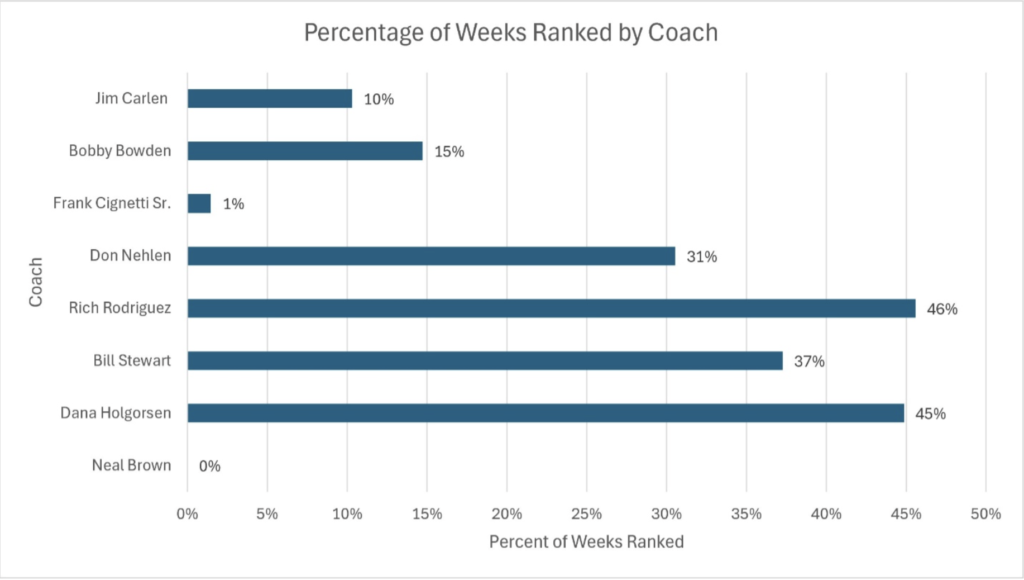
Bill Stewart’s AP appearances often followed a similar pattern during his three full seasons. A strong preseason ranking, followed by losses that eventually dropped the Mountaineers from the poll by the second half of the regular season. Nonetheless, his 37% success rate comes in ahead of Nehlen, demonstrating his ability to field consistent teams during his brief stint as coach.
Surprisingly, Dana Holgorsen achieved a 45% success rate. In his eight seasons at the helm, Holgorsen managed double digit AP appearances four times, as well as seven appearances in another season. Dana failed to reach the heights of his other Mountaineer contemporaries, but he easily established the highest floor for the program for any West Virginia coach; and he managed to do so in the Big 12.
Lastly, the current leader in weeks ranked percentage is Rich Rodriguez. Coming in at 46%, Rodriguez’s totals will soon fall below Holgorsen as he continues his rebuild of the program during his second tenure as coach.
Just as his first tenure, Rodriguez managed no appearances in the poll during his inaugural seasons (2001 and 2025). In his second and third seasons (during his first stint), Rogriguez managed four appearances each year before launching the team into the stratosphere with an average of 14 weeks in the poll across his final four seasons.
Unlike Nehlen, Rodriguez lacked the valleys after the magnificent peaks. But then again, his prior tenure ended before the opportunity fully presented itself.
Leading into year two of the rebuild after the tumultuous Neal Brown era, Rodriguez’s success will be measured by how quickly he can snap the current 119-week unranked streak he has now contributed to.
Rodriguez’s 2025 season, a 4-8 disaster, was a mark worse than any record ever achieved by Neal Brown. However, WVU’s 2025 is a microcosm of a larger story within the program and Coach Rodriguez.
Despite building the 2025 roster using the late portal window, gathering a collection of sub-P4 talent, and experiencing a historic injury epidemic, the Mountaineers beat a ranked Houston team… on the road; another feat Neal Brown never managed.
Rogriguez has always started at new programs slow. According to him, it takes time to build a team properly, even in the NIL era.
Using history as a guide, Rodriguez’s teams have always made second-year leaps under his command. This coincides with WVU attempting to climb from the deepest pit of despair in the program’s history.
As noted earlier, the brightest points in the program’s last sixty years have directly followed years of sorrow.
Looking at 2026 and beyond, the talent composite is incomparable to the year prior; West Virginia welcomed two of its highest rated high school recruits ever – Kevin Brown and Matt Sieg, as well as the nation’s leading rusher from a year ago, Cam Cook, in the transfer portal. The biggest acquisition won’t even take a snap, however, as WVU welcomed hall-of-fame offensive line coach Rick Trickett back to the program.
Sportsbooks currently list the Mountaineers’ 2026 over/under win total at 5.5. Despite the colossal roster upgrade, changes to the coaching staff, and improbable nature of another injury outbreak, bettors expect WVU to only improve by one game to the prior, disastrous season.
Their wagers reflect recent history, an extension of the 119-week unranked streak and memories of the soft, blowout-prone teams of the past two seasons. In reality, West Virginia is primed to cover their expected win total with weeks remaining in the regular season.
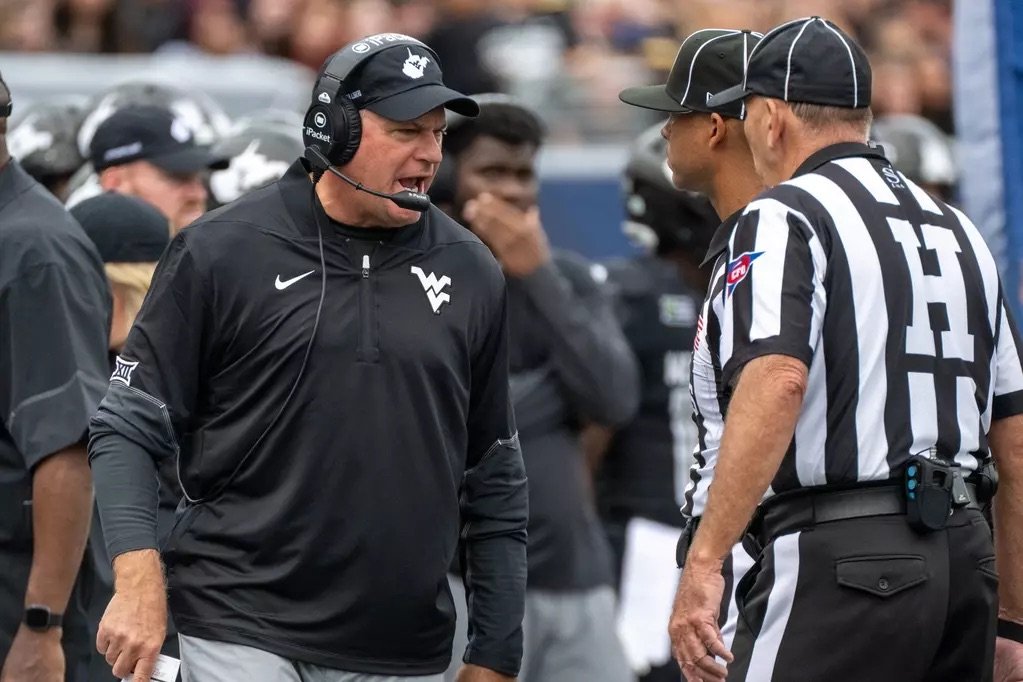
At this time last year, Rodriguez was tense in his press conferences, a symptom of his realization that 2025’s team was not good. Twelve months later, Coach Rod is signing a different tune to the media bullpen at WVU’s practice facility.
When asked about the running back room, Coach leaned back and glistened as he discussed his players.
“It’s been really good competition. The big guy, Amari Latimer, he’s what we thought he was… really good football player.”
Rodriguez wasn’t done, however. He quickly turned his remarks to another member of the backfield.
“And we got Cowboy too. He’s back there as kind of the lone fullback. He might be one of the ten fullbacks or something in college football. There are no fullbacks anymore. We still have a fullback in Cowboy Luke.”
The remark wasn’t a critique of modern roster construction. Sporting an ornery smirk, the remark felt like a wink to the rest of the Big 12. Fullbacks are the embodiment of toughness, an offensive player akin to the old-school maniacal middle-linebackers – and WVU has theirs. His presence, and Rich Rod’s praise, is an indicator that the Mountaineers may have found the toughness they lacked in 2025.
Listening to a press conference of Rick Trickett, he may be illuding to a shift on the offensive front as well.
“I think we’re on schedule with the first group.”
To most, the quote worthless. However, Trickett doesn’t mince words, nor sing praises. His stoic demeanor and demand for excellence derives from his years as a Marine, as well as his years as a trusted confidant and first-assistant to Nick Saban, Bobby Bowden, and Jimbo Fisher. A national champion and coach of countless NFL linemen, Trickett’s personality is closer to Bill Belichick than Pete Carroll. Trickett saying anything positive is an encouraging sign.
Trickett’s 2026 unit could be worth two wins itself. In 2025, a far inferior group was two short-yardage 4th down conversions away from additional victories over Arizona State and TCU, victories that could have hoisted the apathetic 2025 squad’s record to 6-6. Below average (or worse) offensive line play was the difference between bowl eligibility and another offseason of doom and gloom.
Trickett and Rodriguez aren’t alone, however. Defensive coordinator Zac Alley’s press conferences follow suit. Unlike a year ago, Alley appears a bit more relaxed.
“I’m pleased with the buy-in from everyone. As a whole, it feels good. Just getting guys who have been here [since the Spring] going the same direction.”
Like his head coach, Alley is also quick to note the measurable changes to the secondary.
“I think we’re a little further along in the back end.” He would later say “We’ve gotten bigger in the secondary.”
His comments reflect the numerous contested “50/50” balls that WVU defensive backs missed out on in 2025. Their coverage had been sufficient, but their stature failed them against the taller, physical Big 12 receivers.
Now, WVU welcomes Da’Mun Allen, Rayshawn Reynolds, and Geimere Latimer to remedy this issue, all towering secondary players who can attack contested passes.
More importantly, their frames allow them to effectively jam receivers at the line of scrimmage. With disrupted timing, Zac Alley’s aggressive blitzing may have the extra moment needed to get to the quarterback.
Perhaps the biggest change was highlighted by Alley; the continuity between the Spring and Fall practice sessions. In 2025, WVU’s roster was incomplete in March.
Now, a more talented roster has prepared together for longer. Oddsmakers may overlook the Mountaineers, but the pieces are in place for a breakout season and potential return to the AP Poll, no matter what recent history may suggest.
The program is ascending once again and will overachieve in relation to external expectations in 2026. On the heels of a potential eight-win 2026 season, the Mountaineer faithful will ponder the question: Where does the trajectory of this breakout season take us?
Based on the trends hidden in WVU’s history, the answer very well may be conference championships and playoff games in the seasons to come.