Mountaineers Reloading for Another Big 12 Championship Push and a Return to the College World Series
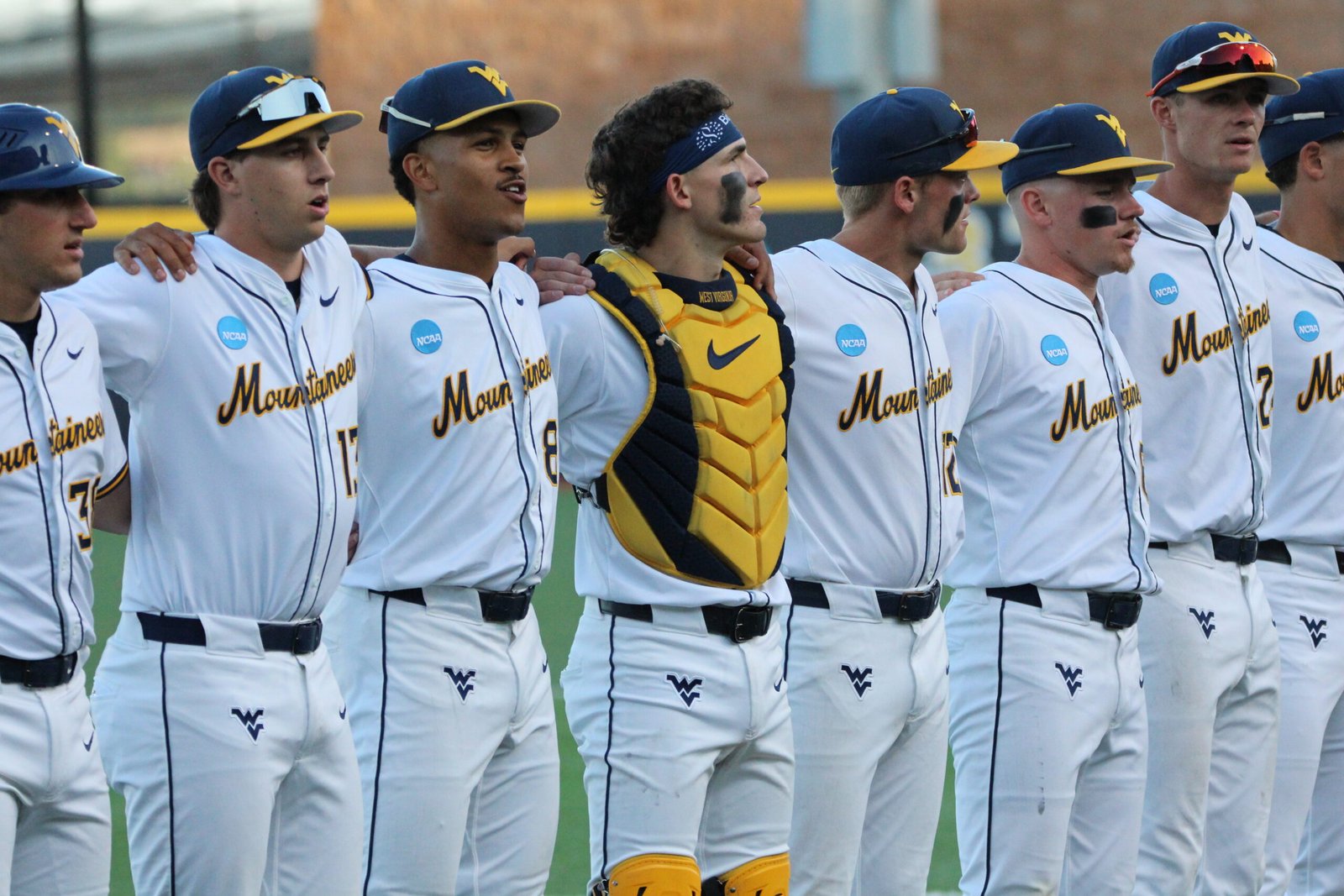
MORGANTOWN, W.Va. — Expectations are beginning to rise once again for WVU baseball.
Following a spectacular 2026 campaign that saw West Virginia finish 47–17 and earn a trip to the College World Series, the Mountaineers enter the 2027 season with something to prove. The question is no longer whether West Virginia can compete with the nation’s best. The question is whether this program can establish itself as one of college baseball’s most consistent national contenders.
With a 55-game regular-season schedule, 30 Big 12 conference games, and a roster featuring a combination of experienced contributors, promising young talent, and potential breakout performers, West Virginia has the pieces to make another serious postseason run.
The road will not be easy. The Big 12 remains one of the most competitive conferences in college baseball. However, the Mountaineers have the opportunity to make another statement.
Based on projected individual performances, roster depth, and the released schedule, West Virginia is projected to finish the regular season 39–16 overall and 21–9 in conference play, good enough for a second-place finish in the Big 12 standings.
And if everything comes together, Morgantown could once again become a difficult place for opposing teams to play.
THE OFFENSE: POWER, SPEED AND DEPTH
The biggest strength of the projected 2027 Mountaineers lineup is its balance.
West Virginia has the potential to combine legitimate home-run power with an aggressive running game and enough lineup depth to create problems for opposing pitching staffs throughout a nine-inning game.
The projected team batting average sits at .290, with the offense expected to produce between 110 and 125 home runs and 400–440 runs scored.
Those numbers would make the Mountaineers a dangerous offensive team, particularly when combining extra-base power with the ability to manufacture runs.
Gavin Kelly: The Offensive Headliner
If there is one player who could become the centerpiece of West Virginia’s offense, it is Gavin Kelly.
Kelly is projected to hit .335 with 22 home runs, 68 RBIs, and 61 runs scored.
Those numbers would put him among the most productive hitters in the conference and potentially establish him as one of the Big 12’s premier offensive performers.
His projected combination of average and power makes him an ideal middle-of-the-order presence. Kelly has the potential to become the hitter opposing pitchers cannot afford to challenge with runners on base.
A season approaching 70 RBIs would make him one of the most important contributors in West Virginia’s lineup.
Armani Guzman: The Game-Changer
While Kelly brings the projected power, Armani Guzman brings something equally dangerous: speed.
Guzman is projected to hit .315 with five home runs, 40 RBIs, 72 runs scored, and an impressive 50 stolen bases.
Fifty stolen bases would make Guzman one of the most disruptive baserunners in college baseball.
His ability to reach base, pressure opposing catchers, advance into scoring position, and create opportunities without needing an extra-base hit could change the entire dynamic of the offense.
Guzman could become the engine that makes the Mountaineers go.
With 72 projected runs scored, he would also have an opportunity to become one of the team’s most consistent offensive catalysts.
The Supporting Cast: Power Throughout the Lineup
West Virginia’s projected offense does not stop with Kelly and Guzman.
Jack Cannon is projected to hit .285 with 17 home runs and 54 RBIs, giving the Mountaineers another potential middle-of-the-order threat.
Tyrus Hall follows with a projected .285 average, 15 home runs, and 50 RBIs.
Matt Ineich could provide another important offensive contribution, with projections of a .300 average, 12 home runs, and 47 RBIs.
Cash Williams adds versatility and power with 13 projected home runs and 44 RBIs.
Chase Ecker brings another dimension, projecting 11 home runs, 38 RBIs, and 11 stolen bases.
Colin Coonradt is projected to contribute 12 home runs and 42 RBIs, while Maxwell Molessa adds another potential power bat with 10 home runs and 35 RBIs.
The depth continues with Creed Erdos, Henkel Acevedo, Jackson Ingram, Weston Mazey, Ryan Piekutoski, Matthew Robaugh, CJ Alfano, Jordan Burwell, Kayden Lipscomb, Seth Williams, Colton Sims, and Joshua Viars.
Seth Williams deserves particular attention. His projected .285 average, 10 home runs, 34 RBIs, and 12 stolen bases could make him a valuable contributor.
The overall picture is encouraging: West Virginia has multiple players capable of producing runs, and the lineup has the potential to avoid becoming overly dependent on one or two hitters.
THE PITCHING STAFF: THE FOUNDATION OF A CHAMPIONSHIP RUN
Offense may attract attention, but pitching will ultimately determine how far the Mountaineers go.
West Virginia’s projected pitching staff features a group of starters capable of providing quality innings, supported by a deep bullpen that could give the coaching staff several options depending on matchups and game situations.
The projected team strikeout total falls between 650 and 720.
That is an important number.
If the Mountaineers can consistently miss bats, limit free passes, and keep opposing offenses from producing big innings, they will have the opportunity to compete against anyone in the conference.
Projected Starting Rotation
Drew Becker — RHP
Projected: 7–3, 3.55 ERA, 72 innings, 82 strikeouts.
Becker projects as one of the anchors of the rotation. His ability to work through opposing lineups and generate strikeouts could make him a dependable weekend starter.
Chansen Cole — RHP
Projected: 7–3, 3.45 ERA, 70 innings, 84 strikeouts.
Cole is projected to be another major contributor. His projected 84 strikeouts would lead this group and give West Virginia another potential frontline option.
Austin Ziance — RHP
Projected: 6–3, 3.70 ERA, 65 innings, 72 strikeouts.
Ziance provides another important piece of the rotation. His projected workload gives the Mountaineers a chance to maintain consistency through the conference schedule.
JJ Glasscock — RHP
Projected: 5–2, 3.80 ERA, 55 innings, 62 strikeouts.
Glasscock offers additional rotation flexibility and could be an important option as the season progresses.
Zak Whitney — RHP
Projected: 4–2, 4.05 ERA, 45 innings, 48 strikeouts.
Whitney provides another arm capable of contributing meaningful innings.
Additional Starting and Multi-Inning Options
The Mountaineers also have left-handed options in Robert Satin, Joshua Surigao, and Colton Hartman.
Satin is projected for a 3.85 ERA across 38 innings, while Surigao carries a projected 3.65 ERA over 36 innings.
I want to add that I do believe Satin will make the rotation at some point, just not within the first couple of weeks of play starting.
Hartman is projected for 30 innings with a 3.95 ERA.
Having multiple left-handed options could give West Virginia additional matchup flexibility, particularly against conference opponents with left-handed-heavy lineups.
THE BULLPEN: DEPTH THAT COULD MAKE THE DIFFERENCE
A successful season requires more than five starting pitchers.
The bullpen must be able to protect leads, escape difficult situations, and provide reliable innings when starters cannot go deep into games.
West Virginia’s projected bullpen has several arms who could become important pieces.
Bryson Hoff stands out as a potential late-inning contributor.
Hoff is projected to finish 4–1 with a 3.10 ERA, 42 strikeouts, and four saves across 34 innings.
Weston Smith follows with a projected 3.45 ERA, 36 strikeouts, and two saves.
Bryant Yoak and Korey Alston are each projected for 31 strikeouts, while left-hander Griffen Paige is projected for 30 strikeouts and a 3.65 ERA.
Additional depth includes Hudson Cavallo, Ben Goodacre, David Hagen, Sean Goldy, JD Costanzo, Brayden Robinson, David Perez, JT Huether, Ben McDougal, Ryan Brown, Colin Harrison, Luke Coats, Blake Krushinski, and Slade Barton.
This depth could become especially important during the demanding Big 12 schedule.
If the Mountaineers can establish dependable roles and identify their most effective late-inning arms, the bullpen could become a major strength.
THE BIG 12: A BATTLE FOR THE TOP
West Virginia’s path to a conference championship will be challenging.
The projected 2027 Big 12 standings feature Kansas, West Virginia, Arizona State, and Oklahoma State as the leading contenders.
Kansas is projected to finish first at 22–8 in conference play, narrowly ahead of West Virginia at 21–9.
Arizona State follows at 20–10, with Oklahoma State projected at 19–11.
TCU and Texas Tech round out the next group of contenders.
Projected Big 12 Standings
- Kansas — 22–8
- West Virginia — 21–9
- Arizona State — 20–10
- Oklahoma State — 19–11
- TCU — 18–12
- Texas Tech — 17–13
- UCF — 16–14
- Cincinnati — 15–15
- Baylor — 14–16
- BYU — 12–18
- Kansas State — 11–19
- Utah — 10–20
- Arizona — 8–22
- Houston — 7–23
The difference between finishing first and fourth could come down to a handful of games.
West Virginia’s projected 21 conference victories would put the Mountaineers firmly in the championship conversation.
The conference schedule includes important matchups against Houston, Kansas, UCF, Arizona State, Baylor, BYU, Cincinnati, Arizona, Oklahoma State, and TCU.
Those series will determine whether West Virginia can maintain its position near the top of the standings.
THE SCHEDULE: NO EASY ROAD TO OCTOBER
West Virginia’s nonconference schedule presents several opportunities to prepare for Big 12 competition.
The Mountaineers are scheduled to face College of Charleston, St. John’s, Indiana State, Michigan, Coastal Carolina, USC Upstate, Maryland, Virginia, Penn State, and Marshall.
These matchups provide a variety of challenges and opportunities to establish the team’s identity before conference play becomes the primary focus.
The projected nonconference record is 18–7.
Combined with a projected 21–9 Big 12 record, that gives West Virginia a 39–16 regular-season finish.
That would be a strong season, particularly considering the turnover and uncertainty that come with building a new roster.
WHAT COULD GO RIGHT?
There are several reasons to be optimistic about the 2027 Mountaineers.
First, the offensive balance is impressive.
Kelly provides power, Guzman provides speed, and the supporting cast has multiple players projected to contribute double-digit home runs.
Second, the pitching staff has several potential weekend contributors.
Becker, Cole, Ziance, and Glasscock could give West Virginia a reliable starting foundation.
Third, the bullpen has enough projected depth to provide different options throughout the season.
Finally, the schedule offers opportunities for West Virginia to establish momentum before the most important conference matchups arrive.
WHAT COULD GO WRONG?
There are also legitimate questions.
Roster turnover can make it difficult to predict how quickly players adjust to expanded roles. Freshmen, transfers, and players with limited college experience will need opportunities to establish themselves.
The Mountaineers must also avoid relying too heavily on their biggest offensive contributors.
If Kelly struggles, Guzman experiences a prolonged slump, or the middle of the lineup fails to produce consistently, the offense could become less dangerous.
On the pitching side, injuries, command issues, and inconsistent starting performances could put additional pressure on the bullpen.
The difference between a 39-win season and a championship-caliber season may come down to how effectively West Virginia handles those challenges.
THE FINAL VERDICT: ANOTHER BIG 12 CONTENDER
The 2027 West Virginia Mountaineers have the potential to put together another memorable season.
The projected numbers suggest a team capable of hitting for average, producing power, stealing bases, and generating enough strikeouts to compete with the best teams in the conference.
Gavin Kelly could emerge as one of the Big 12’s premier offensive players.
Armani Guzman could become one of the most dangerous baserunners in the country.
The projected rotation has several arms capable of establishing themselves as dependable weekend starters, while the bullpen has the depth to provide meaningful contributions.
The projection:
- Overall record: 39–16
- Big 12 record: 21–9
- Nonconference record: 18–7
- Team batting average: .290
- Home runs: 110–125
- Runs scored: 400–440
- Pitching strikeouts: 650–720
- Projected Big 12 finish: 2nd–4th
The ultimate goal remains the same: compete for a Big 12 championship, earn another NCAA Tournament opportunity, and put themselves in position to make another run at Omaha.
West Virginia proved in 2026 that it belongs on college baseball’s biggest stage.
Now comes the challenge of proving it wasn’t a one-time accomplishment.
The Mountaineers aren’t simply looking to follow up a successful season. They’re looking to build a program that expects to compete at the highest level every single year.
And in 2027, the road back to Omaha begins in Morgantown.
Editorial note: All player statistics, records, and standings in this feature are fictional projections based on the supplied 2027 roster and schedule analysis. They are not official WVU forecasts or confirmed player roles.