Shanna Rose | WV Sports Chat
MORGANTOWN, W.Va. — The Big 12 doesn’t rely on reputation alone to stake its claim as the nation’s best basketball conference. It backs it up every night. With elite national contenders at the top, future NBA talent throughout the league and relentless parity from top to bottom, the Big 12 continues to separate itself as college basketball’s most demanding proving ground.
The numbers support it. This season, the Big 12 owns a 16-6 record against the SEC and finished 12-9 against the ACC, consistently holding its own against other power conferences.
At the top sits unbeaten Arizona, the nation’s No. 1 team, while five other Big 12 programs landed in this week’s AP Top 25. The depth is such that national relevance extends well beyond the league’s frontrunners.
The Wildcats enter the heart of conference play at 21-0 after a statement win over No. 13 BYU. True freshman Brayden Burries is shooting 50 percent from the field and 37 percent from beyond the arc. Arizona is averaging nearly 90 points per game and own a 21-point average margin of victory.
Texas Tech, ranked 11th, is surging behind a five-game winning streak and is coming off an upset of Houston. UCF has also emerged as one of the season’s surprises, trucking along with a 16-4 record and adding yet another dangerous matchup to an already crowded slate.
The league’s strength goes beyond wins and rankings. The Big 12 is also home to some of the nation’s top NBA prospects. Kansas’ Darryn Peterson and BYU’s A.J. Dybantas are projected as the No. 1 and No. 2 picks in the upcoming NBA Draft, while Iowa State’s Joshua Jefferson continues to draw attention from scouts.
With that level of talent packed into the top half of the conference, there is no margin for error for anyone chasing a title. Every game carries postseason implications, and every road trip tests a program’s depth, discipline and resolve.
Kansas State head coach Jerome Tang summed up the grind following Tuesday’s loss to West Virginia.
“Man, you get fired up,” he said after Tuesday’s loss to West Virginia. “I mean, we went to Arizona, played the number one team in the country, and we still have to play Houston and Iowa State and Texas Tech and, played. I mean you get those kind of challenges and man, you just got to love it as a competitor, right? To go against that. And then, you know, as the head coach of this program, the CEO of it, to put together a team and build a program that will be on that level.”
There are no nights off in the Big 12. Rankings offer little protection, and one-off performances can quickly derail a season, regardless of opponent or venue.
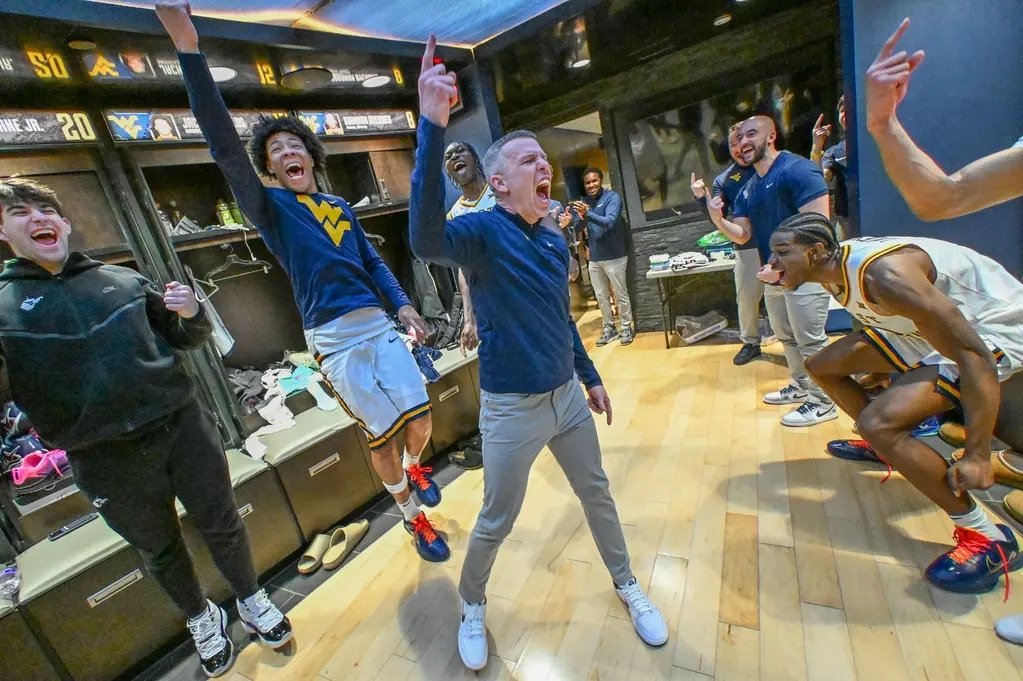
First-year Mountaineer head coach Ross Hodge has already experienced that reality.
“(It’s) a grind, man,” he said. “I’ve told this group it’s the third best basketball league on the planet to me, NBA, EuroLeague, and the Big 12. So many good players, so many good teams. You throw in the travel and the multiple of time zones. And yeah, it just, it’s a grind, man. And it’s unforgiving and you better be able to, to move on, win or lose pretty quick and get to the next thing.”
In a conference where top-25 teams are scattered across the standings and future pros are the norm, survival is never guaranteed. That unforgiving nature — the constant pressure, the depth, the stakes — is exactly why the Big 12 remains the benchmark by which every other conference is measured.
Photo Credit: WVU Athletics